

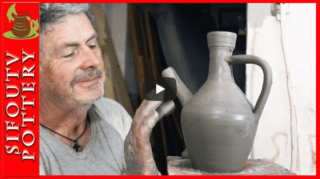
In this video, Kris Neal from Fire & Earth Pottery demonstrates how to throw a sodium silicate vase.
Kris explains the process step by step in the description of the video.
Kris Neal says:
“Here’s how it works-
First I throw a cylinder, but the pulls for this technique are different than for a normal cylinder. I’m trying to gain height, but not lose wall thickness, so it’s several light pulls followed by a hard collaring in and a slide up of my hands. This really just changes the position of the clay, from low and wide, to more slender and tall, but still thick in the wall.
After I get the pot as tall as it can be with a wall thickness of about 3/4 to an inch thick, I run a rib up the exterior to smooth it, and make sure the interior wall is also very smooth.
Next I apply a solution called Sodium Silicate to the outside with a soft brush. The more coats you apply, the bigger the crackle texture.
Once that’s in place, I use a blow torch to heat the surface of the pot (a hair drier or heat gun also works) this dries out the Sodium Silicate, causing the exterior of the pot to become crispy.
Now I wet the interior of the pot only (careful not to let water get on the outside, this might interfere with the crackle pattern).
Next I carefully slide my left hand inside the pot, and rest my left thumb and right middle finger on the rim (where I didn’t apply any solution) for bracing.
Now With my wheel speed slightly higher than for normal shaping, I press outward with my left middle finger, and lift upward pretty sharply, the first couple outward shaping moves can also gain some height if you lift sharply during the move.
Once I get 3/4 of the way up the inside of the pot, I reach just below the rim and push out and slide down.
You’ve got to take this kind of shaping slow, your finger could pop through one of the fractures. Finally I shape the top clay, and there you’ve got your pot!”
Kris Neal was a gifted potter who passed away this year. The pottery community will miss him deeply and we send our condolences to his family, friends, and loved ones. Even though he is gone we are grateful that we can keep his memory and lessons alive through his online videos. We will miss you Kris and thank you for teaching us so many things. Rest in peace. Thank you for teaching us so many things. Rest in peace.




Responses