

Clay Types 101 Guide
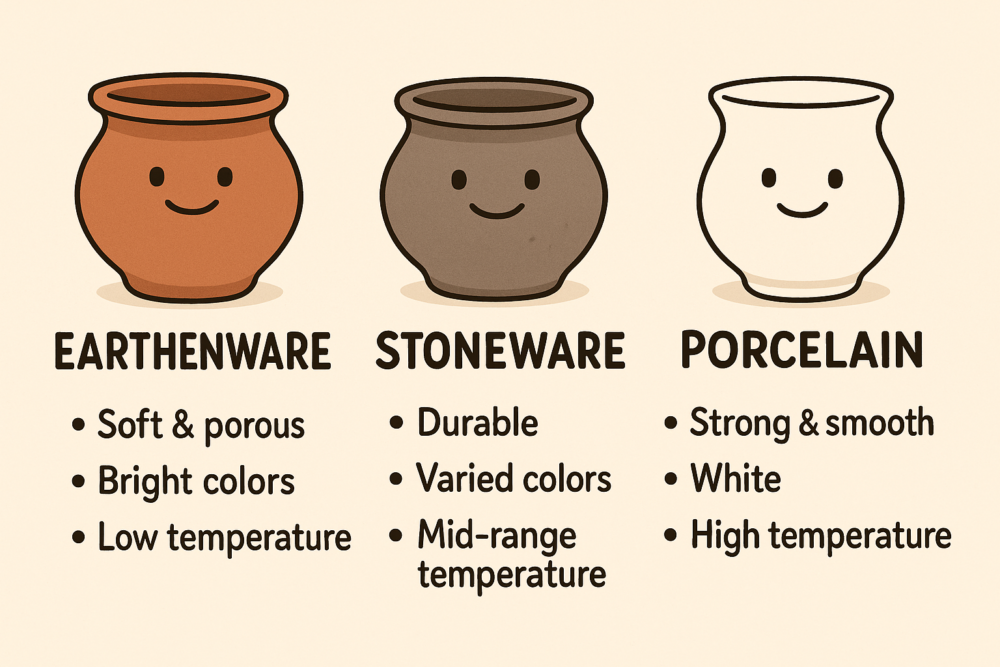
Not all clay is created equal. Just like woodworkers choose between pine, oak, or mahogany depending on the project, potters also have different clays suited for different jobs. The type of clay you pick will change how your pots look, feel, and perform in daily life. Some clays are soft and friendly, others are strong and sturdy, and some are refined and delicate. Learning the differences will help you match your clay to your creative goals.
Earthenware
Think of earthenware as the friendly beginner clay – warm, approachable, and forgiving. It fires at lower temperatures (around Cone 04–1, ~1,000–1,150°C / 1,830–2,100°F), which makes it gentler on kilns and budgets alike.
In your hands, earthenware feels soft and cooperative. It’s often red or buff in color, like the classic terracotta flowerpots you see in gardens. It doesn’t resist you – it bends and shapes easily, which is why many schools and studios introduce beginners to earthenware first.
One of earthenware’s big joys is how bright and cheerful glazes look on it. At low temperatures, colors stay vivid and punchy, almost like crayons on fresh paper. That’s why you’ll often see earthenware in folk art, tiles, and decorative pottery – it holds color beautifully.
But every clay has its quirks. Earthenware stays porous after firing, which means it isn’t naturally waterproof or super durable. You’ll need a good glaze to make it safe for holding water or food, and even then, it won’t be as tough as higher-fired clays. Think of it like softwood in carpentry – great for many projects, but not the best for heavy wear.
- Temperature Range: Low-fire (around Cone 04–1, ~1,000–1,150°C / 1,830–2,100°F).
- Look & Feel: Soft, porous, often red or buff in color.
- Pros:
- Forgiving and easy to shape.
- Bright glaze colors pop well at low temperatures.
- Affordable – great for beginners.
- Cons:
- Not waterproof unless glazed.
- Softer, less durable than other clays.
- Best for: decorative pieces, tiles, bright tableware (with food-safe glaze), or sculpture where strength isn’t the main concern.
Stoneware
If earthenware is the friendly beginner, stoneware is the dependable workhorse. It fires hotter (Cone 5–10, ~1,200–1,300°C / 2,200–2,380°F), which transforms it into something denser, tougher, and naturally non-porous once fully matured (it won’t leak).
In your hands, stoneware feels solid and grounded. It’s usually gray, buff, or brown, and once fired, it has a warm, earthy character. If earthenware is pine, stoneware is oak: strong, versatile, and built to last.
Stoneware is the clay you want when you’re making functional pottery. Mugs that hold coffee every morning, bowls that go through the dishwasher, plates that get stacked and clinked together – it can handle all that. It’s also forgiving enough for beginners but refined enough for pros, making it a true all-rounder.
Its one “drawback” is that glazes fire differently here than on earthenware. Colors are often subtler, more muted – think autumn tones instead of neon brights. But many potters fall in love with this natural, earthy palette because it feels timeless and sophisticated.
- Temperature Range: Mid–high fire (Cone 5–10, ~1,200–1,300°C / 2,200–2,380°F).
- Look & Feel: Dense, strong, ranges from gray to buff to dark brown.
- Pros:
- Very durable and practical.
- Naturally non-porous when fully vitrified (safe for dinnerware).
- Versatile – works for both functional and sculptural ceramics.
- Cons:
- Heavier than porcelain.
- Glaze colors more muted than on earthenware.
- Best For: Mugs, bowls, plates, cookware, and everyday functional ware.
Porcelain
Now, porcelain – that’s the diva of the clay world. It’s dazzlingly beautiful but demands patience and skill. Firing at the highest temperatures (Cone 9–12, ~1,250–1,400°C / 2,300–2,550°F), porcelain matures into an incredibly strong, fine-grained body. Thin pieces can even be translucent / see through and glow when held to the light – like shells or bone china teacups.
In your hands, though, porcelain can be slippery and temperamental. It’s smooth and silky, but it collapses more easily on the wheel and cracks if you rush it. Beginners often describe it as “buttery” but also “fussy.” Working with porcelain is a bit like training a thoroughbred horse – it rewards gentle, precise handling, but it won’t tolerate shortcuts.
The reward is a clay body that’s pure white, elegant, and luminous. Glazes look their truest on porcelain – colors come out bright and clean, with no earthy undertones. That’s why porcelain has long been the material of choice for fine dinnerware, sculptural work, and anything meant to look delicate yet refined.
Best for: fine tableware, delicate functional ware, sculptural pieces where refinement and beauty matter more than ruggedness.
- Temperature Range: High fire (Cone 9–12, ~1,250–1,400°C / 2,300–2,550°F).
- Look & Feel: White, smooth, fine-grained, often translucent when thin.
- Pros:
- Beautiful, refined surface – glazes look glossy and pure.
- Can be made thin and delicate, yet strong once fired.
- Translucency offers unique artistic effects.
- Cons:
- More difficult to work with – soft, collapses easily.
- Less forgiving in drying/firing (more prone to warping or cracking).
- More expensive.
- Best For: Fine tableware, delicate functional ware, sculptural work with elegance.
Choosing the Right Clay for You
- New to clay? Start with earthenware or stoneware – they’re forgiving.
- Want functional ware? Stoneware is your friend – durable, food safe, versatile.
- Chasing refinement? Porcelain will challenge your skills but reward you with stunning results.
Tip: Don’t overthink it – try small bags of different clays and see how each feels in your hands. The clay you enjoy working with most is usually the right one for you.
Related blog posts:
https://ceramic.school/understanding-clay-bodies-part-1-earthenware
https://ceramic.school/understanding-clay-bodies-part-2-stoneware
https://ceramic.school/understanding-clay-types-part-3-porcelain

Responses