


Welcome to Part 4 of our blog series, Understanding Ceramic Glaze Components, where we demystify the basic construction of glazes. In Parts 1-3 we looked at the three foundational components of all glazes: glass-formers, fluxes, and stabilizers.
In today’s post we’re taking a look at a glaze element that is added to these base components that truly brings your glazes to life: color! From vibrant hues that dazzle the eye to subtle tones that evoke tranquility, the colors you choose make a significant impact on your final work.
In this comprehensive guide, we’ll delve into the various types of colorants, their properties, and techniques for harnessing their potential to achieve desired aesthetic effects. Whether you’re a seasoned ceramic artist seeking to deepen your understanding or a curious enthusiast eager to uncover the secrets behind captivating glaze colors, join us as we unravel the mysteries of ceramic glaze colorants together.
What Impacts Color in Glaze
While this may seem like a simple issue of just adding an ingredient or two, creating color in glaze is a bit more complicated than other color-based processes, like mixing paint. But not to worry! By learning what additions and approaches are available to you, you’ll quickly be on your way to making an entire palette of glazes. Here are the main things to look at when you’re trying to achieve a certain color:
Firing Temperature
Different colors are stronger at certain temperatures, and weaker at others. You may have noticed, for instance, that high-fired stoneware tends to feature more earthy colors, while low fired pieces can be very vibrant. This is because many oxides used as colorants lose their vibrancy as the firing temperature increases. For instance, chrome reds can only occur at temperatures of Cone 08 or below.
Firing Atmosphere
Whether you’re firing in oxidation (allowing oxygen during the firing, as with electric firing) or reduction firing (where you remove oxygen during the firing, commonly in gas firings), has a big impact on the color of your glaze. This is because color in glaze is achieved through a chemical reaction, rather than from pigment, so the presence or lack of oxygen changes the chemical response. Oxblood reds, for instance, can only be achieved in reduction firings because copper only produces red when oxygen is removed.
Composition of the Glaze
The ingredients in your glaze play a major role in the development of color. Traditionally we tend to think of color as coming from metallic oxides and stains, both of which we’ll explore more deeply in a moment. But it’s important to understand that these ingredients produce their color not purely in isolation, but in how they react with each other and with other components of the glaze.
You’ve likely learned that certain ingredients are used for certain colors, such as cobalt for blue. But the other ingredients in your glazes, such as those you use for your flux, can have an impact on the tone or intensity of that blue. For example, when cobalt is used in glazes that have a high magnesium content, you can get pinks and violets, but when used with iron and manganese it can produce a deep black.
The overall glaze composition can also affect the nature of the color effect. Sticking with the cobalt example, by adding rutile, you will get a mottled blue rather than an even one.

How to Understand Colorants in Glaze Recipes
If you’re familiar with glazes recipes that are written with ingredients as a percentage out of 100, you’ve likely noticed that certain ingredients are listed below the primary total. These ingredients are all of the things that are not major contributors to our three foundational components (glass-former, flux, and stabilizer). Colorants are included in this collection, as is bentonite (usually used to aid glaze suspension), and opacifiers (which we’ll cover next week). Despite not being part of the 100%, they are still listed in percentages, and usually amount to no more than 5%.
As an example, if you are making a 200g batch of a recipe that calls for 2% copper oxide, you’d use 4g of the copper.
Oxides Versus Stains
Since we’re focusing on glaze chemistry for this series, today we’re primarily going to look at the most common colorants in glaze: stains and oxides. But what are these exactly?
When we talk about oxides in relation to color, we’re primarily talking about metallic oxides. That is, oxides that carry a metal molecule. You may remember us mentioning metallic oxides back in Part 2 when we were talking about fluxes. Both zinc oxide and lead oxide are metallic oxides primarily used for their fluxing properties, but the other metallic oxide we use are for color.
We’ll take a close look at the different oxides in a moment, but before we do it’s worth talking about stains. As we mentioned at the beginning, color is impacted by firing temperature and atmosphere, and this is particularly true for oxides. They become more earthy the hotter you fire, and some colors, such as bright yellow, are unachievable in high fires. On top of this, metallic oxides are often toxic, require significant care in their handling. Ceramic stains were developed as a way around this.
Stains are fired blends of metal and ceramic oxides that have been reground into a fine powder. This has the result of making the color effect of the stain much more stable and consistent, while also reducing the toxicity of the oxide. Like pure oxides, they are at their most vibrant at lower temperatures, but they retain a notably greater vibrance at high temperatures than their raw counterparts.
Stains are often considered to be easier to use than oxides due to their increased stability, but they are still more complex than mixing paint. Like oxides, they’re affected by the rest of your glaze chemistry and kiln atmosphere, just less so. For this reason, it’s important to look up the manufacturers guidelines for the stain you’re using, to see how it may be affected by these factors.
Despite their greater flexibility and ease of use, stains do have a couple of drawbacks. The first is that they aren’t able to produce the same organic-feeling mottled effects of pure oxides. The second is that they are quite pricey due to being a manufactured product. But if it’s vibrancy and predictability you are after, they are an excellent choice!
Metallic Oxides Used in Glaze
Now let’s have a look at the main oxides you’re likely to come across when developing color in your glaze. We’ll cover the range of colors available, as well as the effects of firing and interactions with other ingredients.

Iron Oxide
Iron oxide is the most common colorant in glaze recipes and is used across all firing temperatures. It’s available in Black, Yellow, or Red, each of which have a slightly different chemical composition. Red iron oxide (Fe2O3) is the most common, followed by black iron oxide (Fe3O4). Generally, iron oxide produces warm colors ranging from a yellow-tan to rich brown. It’s a key player in many well-known and sought-after glazes, ranging from tenmoku, celadon, oilspot, tea dust, shino, and more. Iron oxide has noticeable fluxing properties at higher temperatures, and impedes melting at lower temperatures.
In oxidation it produces amber to yellow up to 4% in glazes (especially with lead and calcia), tans around 6%, and browns in greater amounts.
It is very versatile and something of a chameleon, being able to produce both celadon greens and brownish-blacks when used in high concentrations in reduction.
When combined with other oxides it can produce some beautiful variegated effects, particularly with titanium or rutile. When used with tin at high temperatures it can produce a red-breaking mottled tan,
With bone ash it can produce beautiful oranges and reds.
It can produce attractive colors when combined with zinc.

Cobalt
The most powerful of the metallic oxide colorants, cobalt is famous for its rich blue, which it can produce at all firing temperatures. It’s used in very small amounts, usually around only 1%. Both cobalt oxide (CoO) and cobalt carbonate (CoCO3) are used in glaze. The latter is often preferred due to its smaller particle size and slightly reduced intensity. Both have fluxing properties in addition to their strong color, with cobalt carbonate being stronger than cobalt oxide.
When used in glazes with a high magnesium content, very small amounts of cobalt can produce pinks through blue violet. And when fired at cone 9 or higher, this combination can yield blue mottled with red, pink, and purple.
Cobalt with manganese and iron will yield an intense black.
With rutile it can produce mottled and streaky effects.

Copper
Also available in oxide (CuO) and carbonate (CuCO3) form, copper is another very active colorant common to glazes. The carbonate form gives less intense color, but disperses more evenly in the glaze, and is a better melter. Like cobalt, both forms are strong fluxes, so they can increase the glossiness of your glazes. It’s important to note that at cone 8 and above, copper is volatile and can jump from pot to pot. This gives a blushing effect, which may or may not be desirable.
Copper is used in both oxidation and reduction, across a range of temperatures.
Copper produces clear green colors in oxidation glazes. The shade of copper greens can vary with firing rate and soaking changes. The best colors are generally obtained with fast firing and little soaking.
In alkaline glazes it produces turquoise.
With titanium it can produce beautiful blotching and specking effects.
It’s a popular ingredient in raku glaze, yielding metallic copper. Over time, however, the glaze will reoxidize to green. Produces the much-sought-after Copper Red in reduction.
In barium high-fired glazes it produces intense blue and blue-green in both oxidation and reduction.
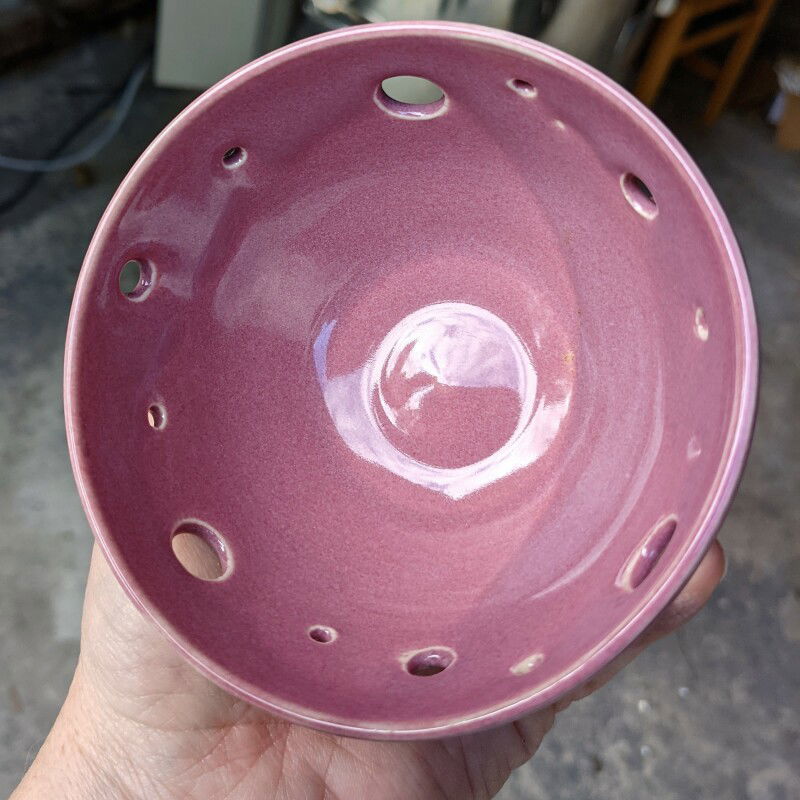
Chrome Oxide
Chrome oxide (Cr2O3) is a highly refractory colorant, so it doesn’t have any of the gloss-enhancing effects of cobalt and copper. It’s a very consistent colorant, producing a matte green across all firing temperatures and atmospheres. It’s powerful as well, requiring only 2% or less to give its signature color, and like copper, is volatile and can affect neighboring pots in the kiln.
- With tin it produces pink.
- With cobalt it yields teals at cone 9 and higher, when fired in reduction.
- With zinc it makes brown.
- With lead it can create reds below cone 08.
- Magnesia can help enhance its color.
- With alkaline fluxes it shifts to a yellower green.
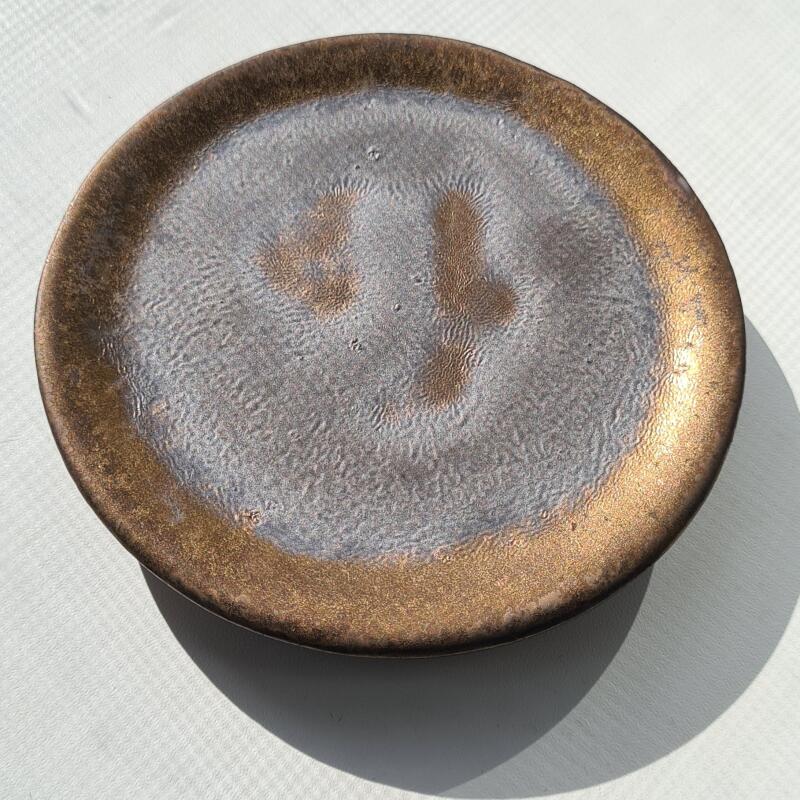
Manganese Dioxide
Most commonly added to glaze as manganese carbonate, this metallic oxide is used to create blacks, browns, and purples. It’s unaffected by reduction, and becomes a flux above 1976F (1080C). It is a less common colorant than the others we’ve covered so far, but it does provide some unique effects.
At 1976F it reacts with silica to produce violet colors in the absence of alumina and browns in its presence.
Also above 1976F, in high concentrations it produces a very metallic bronze.
Manganese browns have a different, often more pleasant character than iron browns.

Nickel Oxide
Known for being a little on the unpredictable side, nickel oxide (NiO) is most often used to subdue or modify other colorants. It’s very refractory, so is generally only used in small amounts, and in mid-high range firings.
In lithium glazes it can produce yellow.
With high magnesium oxide it can produce greens, including acid green, especially with the help of zinc.
With zinc oxide it can produce steel blues to lavender blue, depending on the quantity.
It can produce pinks in high potash or lead glazes.

Rutile
Rutile is a mineral primarily containing titanium oxide, though it generally carries a lot of impurities as well, such as iron oxide, chromium, and tin, among others. It generally produces tans, but offers some excellent varigating properties, as well as some crystallization. For this reason, its value comes primarily for its surface effects rather than its color, but it still makes sense to include it here. It can be used to lighten the color of iron glazes, or soften other vibrant colorants. Surprisingly, rutile can be used to create a beautiful cobalt-free blue glaze as well, aptly named ‘rutile blue.’
As we’ve continued our exploration of ceramic glaze components, we’ve delved into the captivating realm of glaze colorants, a vital aspect of glazing that truly brings them to life. With this comprehensive guide, we’ve uncovered the diverse array of colorants available, each with its own unique properties and potential for aesthetic expression. Armed with this information, you are nearly ready to begin developing your own catalog of colorful glazes. But before you begin, we have just one more stop on our glaze components journey. Be sure to join us for Part 5, where we’ll look at opacifiers, how they work, and where to source them with your glaze ingredients.
And of course, be sure to expand your glaze knowledge by signing up to one of our wonderful glaze-focused workshops! From overglazing techniques to harvesting your own raw materials, you’re sure to find something that will ignite your creativity!




Responses