

Details
| First Name | Beth |
| Last Name | Armour |
| Nickname | barmour |
Social Media
| Website |
My Ceramics
| In the studio I like to do | Handbuilding, Throwing on the Wheel |
| Pottery Wheel | Soldner |
| Clay body | Stoneware, Porcelain |
| Clay Brand | Laguna |
| Kiln Type | Electric Kiln |
| Kiln Atmosphere | Oxidation Atmosphere |
| Temperature | cone 6 and cone 10 |
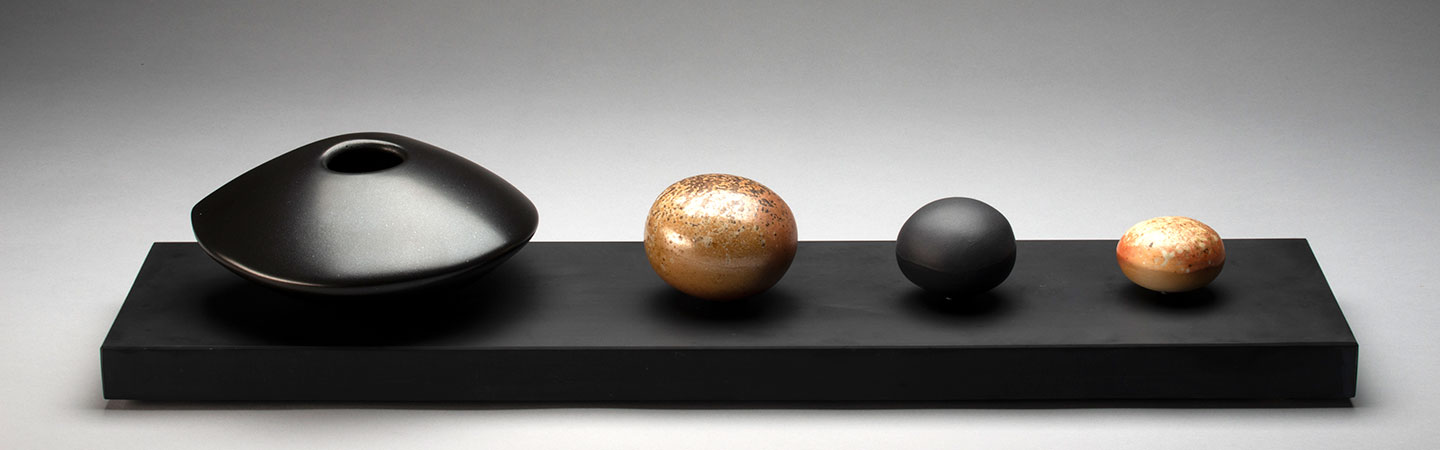
| Glaze | I tend to use semi-matte glazes that I spray on. This allows me to add variation of thickness creating interest in the final glazed piece. I have also been experimenting with a black stoneware and black porcelain that I do not glaze. |
| You can buy my work from | Directly from me through inquiry from pieces posted on my website – https://betharmour.com or through my Etsy shop for my smaller pieces – https://www.etsy.com/shop/BethArmourClay |
About Me
| Introduction | I am a potter/ceramic artist living in Vermont, USA. I primarily work with porcelain, although I have been experimenting with black stoneware and black porcelain for my more sculptural pieces. My pieces are stand-alone contemplative works. They allow form to flourish without the use of highly decorative surface elements. I am intrigued with the Japanese idea of beauty and strive to bring this quality of understated elegant simplicity to my work. I am drawn to surfaces that appear to become part of the piece. A well-used African cooking pot or the surface of tarnished bronze or rusted metal embody the patina that speaks to a certain spiritual beauty only possible with time. I often use black-and-white accentuations that allow a certain illumination to become part of the work in an integral way. |
| What I Love about Ceramics | Everything! The tactile quality, the responsiveness, the making of something from earth. |
| How I started with ceramics | I began my journey with clay in high school. I was immediately drawn to it and went to college specifically to study ceramics. I then apprenticed to a potter who studied in Japan and provided a true Japanese apprenticeship. Such an education! |
| My Artist Statement | I came to art at a young age. I explored a variety of mediums before discovering clay and the pottery wheel in high school. There was no turning back. In college I studied pottery and anthropology, which increased my interest in artifacts and instruments of daily use. My studies focused on the aesthetic and cultural significance of Yoruba art of West Africa. My travels to Ghana, Africa gave me the opportunity to visit many local potters and artisans. Later, I apprenticed with master potter Malcolm Wright which led to my interest in Japanese aesthetics. I started my career as a production potter, but my interest in vessels, particularly as cultural and functional forms, grew. I soon realized the artistic possibilities of vessels that transcended serving as containers and receptacles. I saw them as forms that reflected space yet intimacy, interior and exterior harmony, and unique structural pieces of art. Those possibilities inspire my work today. My pieces are stand-alone contemplative works. They allow form to flourish without the use of highly decorative surface elements. I am intrigued with the Japanese idea of beauty and strive to bring this quality of understated elegant simplicity to my work. I am drawn to surfaces that appear to become part of the piece. A well-used African cooking pot or the surface of tarnished bronze or rusted metal embody the patina that speaks to a certain spiritual beauty only possible with time. I often use black-and-white accentuations that allow a certain illumination to become part of the work in an integral way. My work as a production potter for many years has provided me with the technical skills, allowing me the freedom to be more creative and imaginative as an artist. I’m drawn to the smooth tactile quality of porcelain as well as the many challenges of throwing with porcelain clay and its demand for me to stay present and focused throughout the creative process. As I continue to explore the vessel, I look forward to experimenting with different surfaces, shapes and firing techniques. The process of creating new forms, and interacting with the public, is so gratifying and intriguing. It’s a kind of collaboration that gives my work a new level of meaning. Feedback pushes me in new directions that wouldn’t happen otherwise. |
