

Welcome to Part 2 of our exciting series on fuel-burning kilns! If you’ve only ever worked with electric kilns, the transition to fuel-burning kilns can feel overwhelming. There are so many variations and factors to understand, it can be difficult to know where to start. We’re here to simplify your fuel-burning journey by demystifying all of these variables. In Part 1 of our introduction to fuel burning kilns, we looked at some of the reasons you may want to try these kilns, from the unique effects of reduction, to the ability to fire off-grid. In today’s article, we’re going to take a look at the types of fuels available, and the benefits and drawbacks of each one.

Wood
Wood is the most common solid combustible fuel used by today’s potters, as well as one of the oldest fuels to be used with clay in human history. It’s a versatile material that can be used at low temperatures in sawdust form, or at high temperatures in split log form. In high-fire environments it imparts beautiful and unique effects on the pots, as the ash from the wood disperses through the kiln to create flashing, fluxing, and texture to glazes, as well as imparting nice toasty warmth to areas of unglazed clay. You can expect a wide variety of results within a single firing, with no two pieces being the same. Both reduction and oxidation are possible.
Firing to high temperatures with wood is very labor-intensive and requires a purpose-designed downdraft or crossdraft kiln (which we’ll talk more about in Part 3 of this series). The firing process requires constant attention, with regular stoking and clearing of embers. There is a definite learning curve involved in understanding the rhythm of this process, but once learned the firing becomes something of an intuitive dance. The labor involved, combined with the long firing time, can be reduced by firing with a small group of potter-friends, which has the added benefit of turning the firing into a fun social event.
In addition to the labor of the actual firing, wood firing can come with the additional work of splitting and stacking the wood. You’ll also have to consider the storage requirements needed to keep sufficient wood on hand and to keep it nice and dry. And, as not all woods burn the same, you’ll need to do a bit of research into which types are best for you. Most artists use a mixture of hard and soft woods, and many are increasingly turning to using untreated scrap woods to reduce their environmental impact.

Gas
Gas is the most common combustible used in fuel-burning kilns, and there’s a good reason why. Gas is cleaner burning than wood, can be used for oxidation and reduction, and is readily available. In many places, these fuels are much more cost-effective than electricity, which is a notable benefit. Propane and natural gas are the most commonly used, each requiring a different type of burner jet.
One of the biggest benefits of gas over wood is that it is not labor intensive. No stoking is required, and large amounts of space for fuel storage are also unnecessary. Cleaning is also easier as there’s no ash produced. You won’t be able to achieve the same aesthetic effects as wood, but with such a wide variety of other results available, the benefits can easily outweigh this drawback.
While computerized gas kilns are available, it’s much more common to fire using a thermocouple and pyrometric cones, so for this reason they require more vigilance than automated electric kilns. They are faster firing than electric kilns and are capable of reaching higher temperatures, however, so it can be a worthy trade-off.
The main draw-back of gas kilns is their initial cost. Since they require special ventilation, as well as connection to gas lines, the set-up is more involved and therefore on the pricier side. For the same reason, they are less portable than their electric counterparts. Additionally, the use of pressurized gas requires extra safety precautions.

Oil
Oil burning kilns are perhaps the least common of today’s fuel-burning kilns, but they are a worthy consideration. They produce similar results as gas firing, and depending on the type of oil used, can be cleaner burning than gas. In fact, a major benefit of oil-burning kilns is the ability to use bio-fuels, such as used vegetable oil or corn oil, which produce very low hydro-carbon, soot and nitrogen emissions. These oils are a major waste component of the food industry, so repurposing them is not only great for the environment, but it means you can likely source them for free from your neighborhood restaurants.
Using oil in a kiln does require a more complex burner system than what you find in a gas kiln. There are several designs available, with the main two being oil-drip burners, and atomizer and quarl systems. With the former, oil is gravity fed over preheated metal plates that are mounted vertically in front of the fire mouth. When the oil contacts the hot plates it ignites and forms the burner, and air is drawn through the plates to maintain the flame. These can be used with or without a fan to aid the airflow, and the heat is controlled by increasing or decreasing the flow of the oil.
As the name would suggest, the atomizer and quarl system is a two part system. The quarl faces into the firebox, and is a refractory block that is preheated with either wood or gas. The atomizer is outside of the kiln and is connected to an oil feed and a forced-air supply such as a fan. When the oil is sprayed through the atomizer and contacts the heated quarl, it ignites and goes into the kiln, aided by the airflow of the fan.
These two systems allow for a firing that is very easy to control in terms of both temperature and atmosphere.
Other Fuel Options
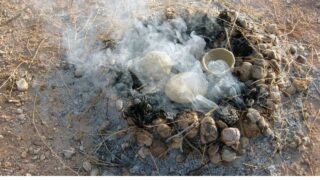
The above three fuel types are certainly not the only options. Coal of course was once commonplace, but for environmental reasons is no longer preferred. If you are firing to lower temperatures, paper, dung, seaweed and many other materials are all possibilities. When experimenting with different combustibles, be sure to do some research on any possible harmful emissions, and fire in a well ventilated area.
Understanding the types of fuels available for kilns is invaluable for making an informed decision that aligns with your firing goals and practical needs. By exploring the benefits and drawbacks of each fuel type, you can better appreciate the versatility and unique outcomes that fuel-burning kilns offer. Stay tuned for Part 3, where we will delve into the different design types available for fuel-burning kilns, along with their benefits and drawbacks.
If you would like to learn more about kilns and firings, be sure to check out Vicente Garcia’s “How to get amazing results with saggar firing” workshop. Saggar firing offers an exciting alternative method for achieving reduction results in the kiln, and Vincente will walk you through the process step-by-step!



Responses